

We have a song in our home that has become a staple in our daily music listening. Matthew West – Truth Be Told
I say, “I’m fine, yeah, I’m fine, oh, I’m fine, hey, I’m fine”, but I’m not
I’m broken
And when it’s out of control I say, “It’s under control”, but it’s not
And you know it
I don’t know why it’s so hard to admit it
When being honest is the only way to fix it
There’s no failure, no fall
There’s no sin You don’t already know
So let the truth be told
Today’s generations, Gen Z and Millennials, have created a new dichotomy when it comes to truth: “my truth” versus “truth is truth.” In the minds of many young people, there seems to be no such thing as absolute facts—a concept we might call “fictional non-fiction.” This opens up a society where accountability is lacking, and falsehoods are common. The challenge is determining how to distinguish truth from lies.
As a foster parent, I encounter many lies. This is one of the hardest parts of fostering. These children have experienced so much abuse and neglect that lying becomes a survival tool. It can be painful, especially when the lies are directed at you. We’ve been dealing with this issue for several years with one of our former foster children, who is now our adopted daughter. To this day, she refuses to speak to us. Over the past few years, we’ve heard numerous stories she’s told others about her time with us.
I’ve tried several times to discuss these stories with her to get to the root of the issue, but she always shuts down the conversation. She says things like, “I’m not talking to you,” or “My boyfriend will talk to you, but not about the past.” When she was younger, we made sure to stay in touch with the parents of her boyfriends and friends to address any lies that arose. These parent-to-parent relationships went a long way in mitigating concerns. However, as an adult, she has ensured that these connections don’t happen with her future in-laws. They refuse to talk to us for any reason, and we have been completely cut out of her life and our grandson’s life. She maintains these barriers to prevent her web of falsehoods from unraveling.
Do I blame her? No. Lying has become a survival skill she has honed to navigate life. According to the Newport Institute, childhood trauma, such as neglect or abuse, can lead to pathological lying. People who didn’t have their needs met as children might lie as a coping mechanism to gain the love and reassurance they crave. They might also internalize the message that they are not good enough as they are, leading them to lie to conceal what they perceive as unforgivable personal flaws that make them unworthy of love.
The Dos and Don’ts of How to Deal with a Pathological Liar
If you know someone who repeatedly lies, here are a few approaches for coping with this problematic behavior.
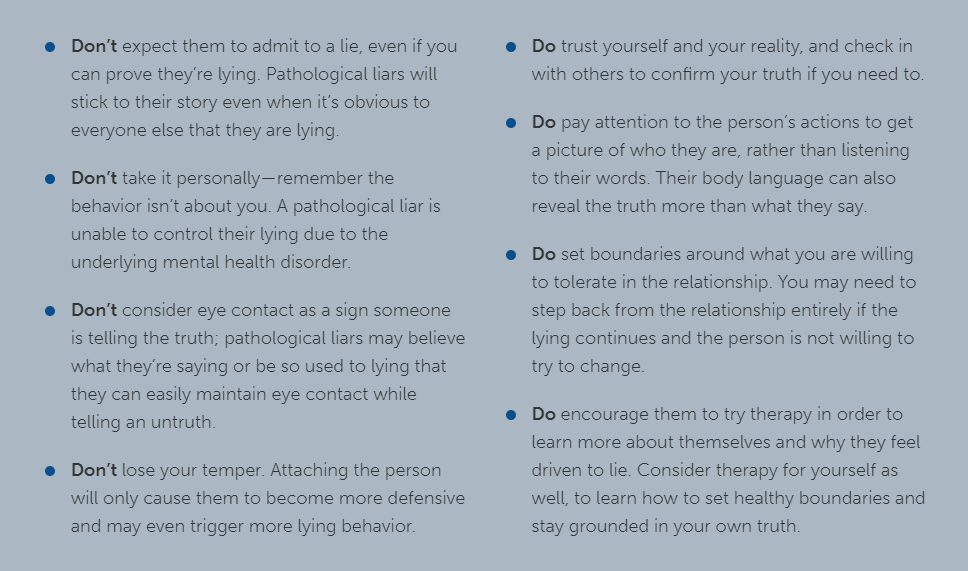
There is so much in this article to absorb please take time to read it. Click here
I will say dealing with this issue has been one of the hardest things we have faced it has come with a lot of hurt, and self reflection. I have spent more time poring over the lies in my head that have been told then what I should have. Its so hard to be rejected by the child you chose and adopted into your family. We feel betrayed, used, and manipulated.
 Chronicles of a at Home Dad
Leave a comment